Project Background
AT-RISK CHILDREN IN ETHIOPIA
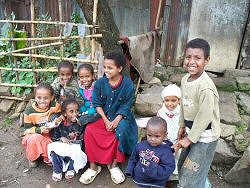
The large number of at-risk children in Ethiopia, whose needs are not being met, or even addressed, creates an urgent situation requiring an immediate and serious response. Of the 70 million people living in Ethiopia, approximately half are under the age of 18 years. Approximately 1.3 million persons (3.5% of the population) are living with HIV/AIDS. An estimated 870,000 children have been orphaned by the virus, and the total number of children orphaned due to all causes is 4,800,000. A major barrier to provision of adequate care for these children is pervasive poverty and other related problems. Ethiopia is one of the poorest countries in the world; it is estimated that 80% of its people live on less than $2 USD a day. Social, health, and economic needs have contributed to a life expectancy of 48 years.
Ethiopia does not have a well developed or effective system to respond to the needs of orphans and vulnerable children (OVC) or their families. The care and services that are available are largely provided by NGOs, both local and international. Available services are not well coordinated and wide disparities exist in terms of the quality of services provided and the qualifications of staff responsible for responding to the needs of orphans and vulnerable children. Often individuals are hired to work with children and families who have no special training or education for working with this population. Many children are placed in orphanages that provide physical care, but do not address the psycho-social needs of children. Others receive little or no services, and many of those fend for themselves, living on the streets exposed to many kinds of risks and abuse. A growing number of children, many of whom have a living parent and extended families, are sent abroad through international adoption.
INTEGRATING COMMUNITY DEVELOPMENT AND CHILD WELFARE
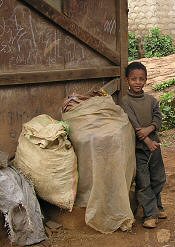
The large number of orphaned and vulnerable children (OVC)—combined with pervasive poverty and the lack of an effective service delivery system—creates a situation that requires a new and comprehensive approach to child welfare intervention. We believe that a next step toward the development of an effective child protection system in Ethiopia includes two major components: 1) education and applied training for child and family community workers, including a train-the-trainer (TOT) approach to develop a cadre of Ethiopian trainers for the future; and 2) an organizing, advocacy, and development process for establishing certification standards for child and family community workers. The CD-CW Project trains workers from government and non-governmental organizations (NGOs), in an effort to scale up training for child and community workers by district and regional governments in Ethiopia.
The CD-CW model of training is competency based and incorporates evaluation measures to assure that
trainees have in fact developed the requisite competencies. The content of the training is innovative.
It encompasses a model that has been created as a result of the expertise developed by our team through
international work in the fields of child and family services and community development. The integration
of these traditional fields of practice gives direct attention to poverty reduction as a method of preventing
child abuse, and works with communities, groups, and organizations in developing family-centered and
 community-based systems of care. CD-CW training is innovative and holistic in that it integrates child
welfare and community development. It is both protective and preventive—it works to ensure children's
rights by building the capacity of families to provide, care for, and protect children by improving their
skills in parenting and to reduce poverty through family based community development. The logic of our
thinking is outlined below:
community-based systems of care. CD-CW training is innovative and holistic in that it integrates child
welfare and community development. It is both protective and preventive—it works to ensure children's
rights by building the capacity of families to provide, care for, and protect children by improving their
skills in parenting and to reduce poverty through family based community development. The logic of our
thinking is outlined below:
- Families are essential for the healthy growth and development of children; the family is the environment that best promotes the child’s growth and well being.
- Poverty impedes the ability of families to protect and nourish children, and the role of children in protecting themselves and supporting their families. The new shift—especially in low income families—is that older children are taking the responsibility for their younger siblings, as well as being caretakers for mothers and grandmothers and family members with disabilities.
- A holistic child protection system must deal with family poverty; it must build upon and support the strengths and capabilities of families to care for children outside of institutions and service programs. D espite the fact that several adverse effects remain, a holistic child protection system must also learn how resilient families still maintain good parenting and raise their children properly.